 |
Bridges-Python
3.2.0
Bridges(PythonAPI)
|
|
Bridges-Python
3.2.0
Bridges(PythonAPI)
|
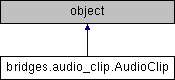
This class provides support for reading, modifying, and playing, audio waveform.
This class provides a way to represent an AudioClip (think of a WAV file) in Bridges as waveforms.
An AudioClip can be composed of multiple channels: a stereo sound would be composed of 2 channels (Left and Right), a mono sound would be composed of a single channel. A 5.1 sound would be composed of 6 channels. When building an AudioClip from a file, the number of channels is taken from the file; some constructors have a num_channels parameter that enables to pass the number of channels explicitly. If unsure, one can know how many channels are in an audio clip using get_num_channels().
Each channel is essentially a 1D signal. That is to say, it is an array of values that represent how far the membrane of a speaker should be from its resting position. The quality of the sound is controlled by two parameters: sampling rate and sampling depth.
Sampling rate tells how many positions per second are encoded by the AudioClip. It is expressed in Hertz. CD quality is 44100Hz; while walkie-talkies use 8000Hz. It is set automatically if read from a file; or it can be passed as the sampleRate parameter to some of the constructors. The sampling rate can be obtained from an AudioClip using get_sample_rate().
The length of an AudioClip is expressed in number of samples. So if an AudioClip is composed of 16,000 samples with a sampling rate of 8000Hz, the clip would be 2 seconds long. The number of samples can obtained with get_sample_count(); it is set from a file or can be passed as the sampleCount parameter of some of the constructor.
The sampling depth indicates how many different positions the membrane can take. It is typically expressed in bits with supported values being 8-bit, 16-bit, 24-bit, and 32-bit. If a clip is encoded with a depth of 8 bits, the membrane can take 2^8 different position ranging from -128 to +127, with 0 being the resting position. The sampling depth is read from files or passed as the sampleBits parameter of the constructor. The sampling depth of an existing clip can be obtained with get_sample_bits().
The individual samples are accessed with the get_sample() and set_sample() functions. The samples are integer values in the 2^(get_sample_bits()-1) ; 2^(get_sample_bits()-1)[ range. The functions allow to specify for channel and sample index.
Public Member Functions | |
| def | __init__ |
| def | get_num_channels (self) |
| Return the number of channels in this AudioClip. More... | |
| def | get_channel |
| Get the audio channel at index. More... | |
| def | get_sample_rate (self) |
| Get the sample rate of this audio clip. More... | |
| def | get_sample_count (self) |
| def | get_sample |
| Get the sample at the index of the sample data from a specific channel. More... | |
| def | set_sample |
| Set the sample at the index of the sample data to value. More... | |
| def | get_sample_bits (self) |
| Get the number of bits for the samples in this audio clip. More... | |
| def | get_sample_bytes (self) |
| Get the number of bytes for the samples in this audio clip. More... | |
| def | get_data_structure_type (self) |
| Get the data structure type. More... | |
| def | get_data_structure_representation (self) |
| Return a dictionary of the data in this audio file. More... | |
| def | display (self) |
| Print information about this audio file to the console. More... | |
| def | audio_from_json |
| Create an AudioClip from a json dictionary created by another AudioClip object. More... | |
Public Attributes | |
| sample_count | |
| sample_rate | |
| sample_bits | |
| num_channels | |
| framebytes | |
| def bridges.audio_clip.AudioClip.__init__ | ( | self, | |
| filepath | |||
| ) |
| def bridges.audio_clip.AudioClip.audio_from_json | ( | json_dict | ) |
| def bridges.audio_clip.AudioClip.display | ( | self, | |
| None | |||
| ) |
Print information about this audio file to the console.
| def bridges.audio_clip.AudioClip.get_channel | ( | self, | |
| index | |||
| ) |
Get the audio channel at index.
The index should be less than get_num_channels().
(int) index: The index of the channel to get. 0 for front-left, 1 for front-right, etc.
| def bridges.audio_clip.AudioClip.get_data_structure_representation | ( | self, | |
| dict | |||
| ) |
Return a dictionary of the data in this audio file.
| def bridges.audio_clip.AudioClip.get_data_structure_type | ( | self, | |
| str | |||
| ) |
Get the data structure type.
| def bridges.audio_clip.AudioClip.get_num_channels | ( | self, | |
| int | |||
| ) |
Return the number of channels in this AudioClip.
1 for mono, 2 for stereo, etc.
| def bridges.audio_clip.AudioClip.get_sample | ( | self, | |
| channel | |||
| ) |
Get the sample at the index of the sample data from a specific channel.
(int) channel: The index of the channel to get. 0 for front-left, 1 for front-right, etc. (int) index: The index of the sample to get. From 0 - get_sample_count()
| def bridges.audio_clip.AudioClip.get_sample_bits | ( | self, | |
| int | |||
| ) |
Get the number of bits for the samples in this audio clip.
Will be 8, 16, 24, or 32 bits.
| def bridges.audio_clip.AudioClip.get_sample_bytes | ( | self, | |
| int | |||
| ) |
Get the number of bytes for the samples in this audio clip.
Will be 1, 2, 3, or 4 bits.
| def bridges.audio_clip.AudioClip.get_sample_count | ( | self, | |
| int | |||
| ) |
| def bridges.audio_clip.AudioClip.get_sample_rate | ( | self, | |
| int | |||
| ) |
Get the sample rate of this audio clip.
This is the number of samples that are taken in one second.
| def bridges.audio_clip.AudioClip.set_sample | ( | self, | |
| channel | |||
| ) |
Set the sample at the index of the sample data to value.
(int) channel: The index of the channel to get. 0 for front-left, 1 for front-right, etc. (int) index: The index of sampledata to set which must be less than get_sample_count() (int) value: The value to set the sample to which must be a valid signed integer with bit length get_sample_bits(). That is to say in the [-2^(get_sample_bits()-1) ; 2^(get_sample_bits()-1)) range).
| bridges.audio_clip.AudioClip.framebytes |
| bridges.audio_clip.AudioClip.num_channels |
| bridges.audio_clip.AudioClip.sample_bits |
| bridges.audio_clip.AudioClip.sample_count |
| bridges.audio_clip.AudioClip.sample_rate |
 1.8.13